"Unsupervised Deep Clustering for Human Behavior Understanding" Accepted and Presented at ACM HumanSys 2025

Our paper, “Unsupervised Deep Clustering for Human Behavior Understanding” has been accepted for publication in ACM HumanSys 2025, co-located with CPS-IoT Week 2025!
In this work, we propose Compressed-Pseudo-Temporal Enhanced Representation Learning (C-PTER), a novel unsupervised clustering framework for human-centered behavior analysis (architecture shown above). With the growing prevalence of wearables, smartphones, and IoT devices, vast amounts of human activity data are collected in real-world settings, yet traditional supervised learning approaches require extensive manual labeling, making them impractical for large-scale deployment. Existing deep clustering methods, such as autoencoder-based approaches, often fail to capture temporal dependencies and struggle with noisy sensor readings, leading to suboptimal clustering performance.
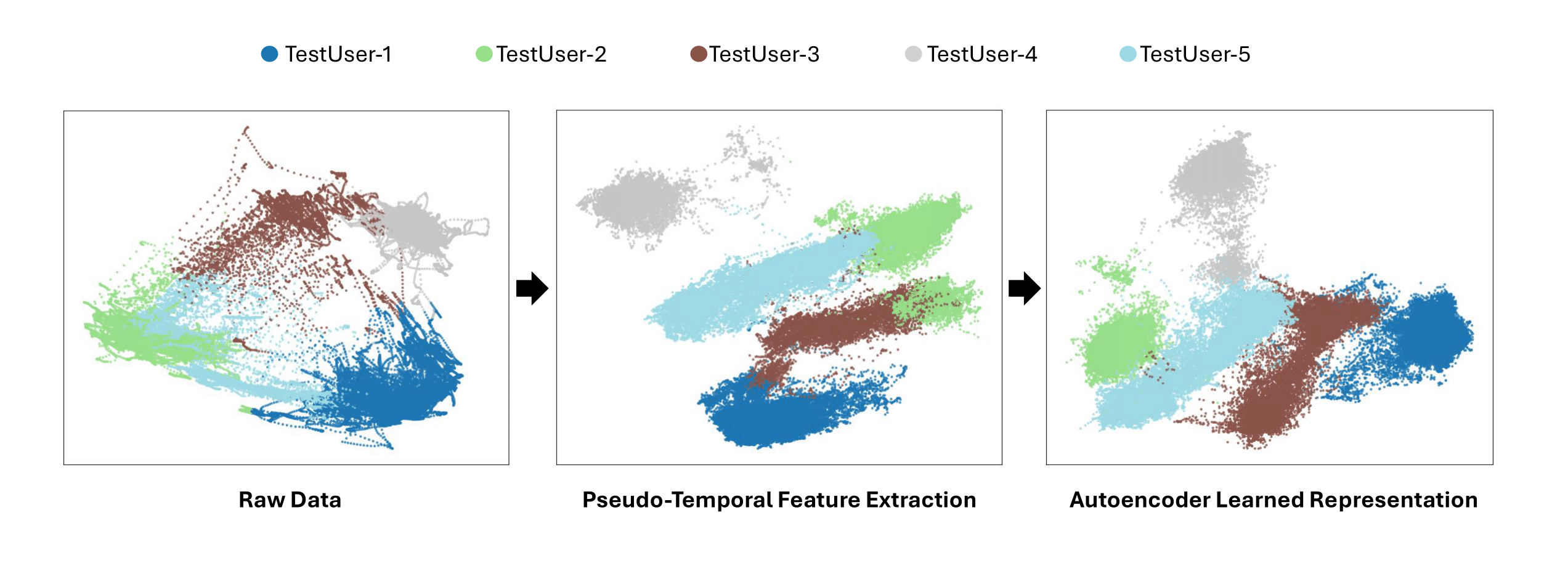
C-PTER proposes a pseudo-temporal feature extractor with a parallel CNN-LSTM autoencoder to enable robust spatial-temporal representation learning. We demonstrate up to 30% improvement in normalized mutual information and 21% improvement in downstream task performance on a variety of human activity datasets, compared with existing state-of-art clustering methods.
Congratulations to Weisi Yang and the rest of the team!